AI Customer Service vs. Human Agents: Not a Replacement, But a Division of Labor

Brandon Lu
COO
Every time AI customer service comes up, someone asks the same question: "So you're replacing all the customer service staff?"
The answer is no — and doing so would almost certainly backfire.
Routing all customer calls to AI, or keeping all calls with human agents, are both suboptimal strategies. The former fails at the moments when customers genuinely need empathy and judgment. The latter keeps your human workforce perpetually consumed by high-volume, repetitive, standardized queries.
The real question isn't "AI vs. human agents — which is better?" It's "which calls should AI handle, which should humans handle, and when should a call transfer from AI to human?"
The Core Logic of Division of Labor: Two Dimensions Decide
Two dimensions determine whether a call should be handled by AI or a human agent.
Dimension 1: Problem complexity. Queries with standard answers (order status, billing amounts, business hours) are low complexity. Problems requiring cross-system investigation, exception judgment, or policy discretion (complex complaints, special refunds, contract disputes) are high complexity.
Dimension 2: Customer emotional intensity. Calmly requesting information is low emotion. Anxious, angry, distressed, or facing an emergency is high emotion.
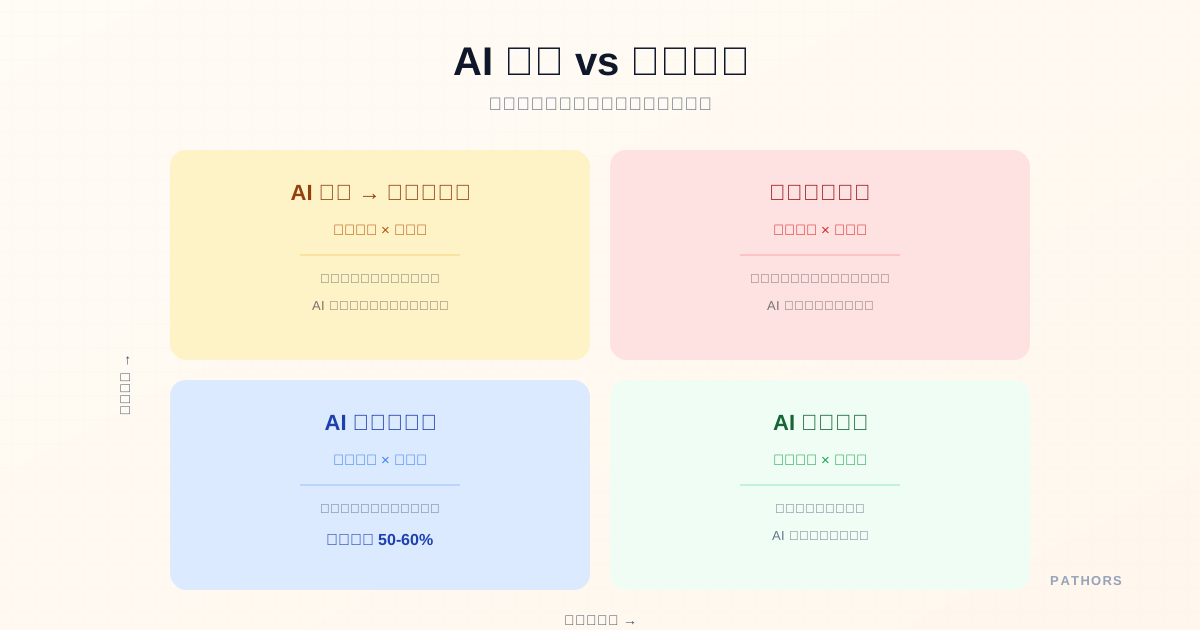
Map these two dimensions into four quadrants:
Low complexity × Low emotion → Full AI automation. This is AI's sweet spot. "Where's my package?" "When's my next appointment?" "What are your hours?" Standard answers, customers just need information, no emotional weight. These typically represent 50–60% of total call volume.
Low complexity × High emotion → AI first, fast transfer to human. The customer's question might be simple ("I've been waiting three days for my package") but emotions are already running high. AI can collect basic information and check system status with an empathetic tone, then transfer to a human with fully organized context. The human picks up without needing to ask from scratch — going straight to resolution.
High complexity × Low emotion → AI assists human. The customer is calmly asking a complex question ("I want to compare these three plans" or "My contract is up and I want to discuss renewal terms"). The human leads the conversation and judgment; AI provides real-time information support in the background — pulling customer history, calculating plan differences, suggesting response scripts.
High complexity × High emotion → Full human handling. Serious complaints, legal disputes, urgent safety situations. These require human judgment, empathy, and in-the-moment response. AI's role moves to the back: post-call content analysis, flagging emotional turning points, generating reports.
The Timing of Transfer Matters More Than the Transfer Itself
Many businesses set a simple transfer rule when deploying AI: "If AI can't understand, transfer to human." This seems reasonable, but in practice causes an enormous number of unnecessary transfers — AI might just temporarily not understand how a customer phrased something, and one additional clarification would let it continue.
Better transfer design should be based on these triggers:
Customer explicitly requests it. "I want to speak to a person" — this is the highest-priority trigger and should always be honored immediately.
Emotional temperature exceeds threshold. AI detects through voice analysis that the customer's speech rate has accelerated, volume increased, or emotionally negative words are being used. Don't wait until the customer explodes to transfer.
Same issue repeated three times. If AI fails to correctly understand or resolve the customer's issue three consecutive times, the call has exceeded AI's capability range.
Amount exceeds threshold. For decisions involving money — refunds, claims, contract changes — set an amount threshold based on company authorization policy. Transfers exceeding the threshold go to a human with the relevant authority.
Three-Phase Roadmap for AI Customer Service Deployment
If you're thinking about how to approach customer service automation, a phased approach is recommended.
Phase 1: AI takes over low-complexity × low-emotion calls. This is the lowest-risk, most immediately impactful starting point. Handing 50–60% of standardized queries to AI immediately relieves human agent workload. This phase typically goes live in 2–4 weeks.
Phase 2: Build seamless AI-to-human handoff. Have AI pass a complete conversation summary and customer context when transferring. Humans pick up without needing to re-ask anything. The focus of this phase is transfer experience — customers should not feel like they're being passed around.
Phase 3: Activate AI-assist capabilities. When humans are handling complex issues, AI provides real-time support in the background — customer history, suggested responses, relevant policy text. At this phase, AI isn't facing customers directly; it becomes the agent's "co-pilot."
Pathors' Human-AI Collaboration Design
Pathors' AI voice customer service platform treats human-AI collaboration as core architecture rather than an afterthought. Specifically:
A visual SOP editor lets you define AI handling scope and transfer triggers for each scenario. At transfer, AI automatically generates a conversation summary for the human agent. All AI-handled calls have complete conversation records and sentiment analysis, making it easy for supervisors to review quality and optimize flows.
Want to see how human-AI collaboration works in your customer service scenario? Book a free Demo.
Brandon Lu
COO
Passionate about leveraging AI technology to transform customer service and business operations.
Ready to Transform Your Call Center?
Schedule a personalized demo and see how Pathors can revolutionize your customer service
Pathors empowers businesses with intelligent voice assistant solutions, streamlining customer service, appointment management, and business consulting to enhance operational efficiency.