How Clinics Use AI Voice Agents to Cut 70% of Front-Desk Phone Time

Brandon Lu
COO
Walk into any busy medical clinic and you'll see the same scene: a front-desk receptionist holding a phone to one ear while typing into the scheduling system, confirming appointment details with the caller. Meanwhile, three patients are waiting to check in, one person wants to know when their lab results will be ready, and the phone is already ringing again.
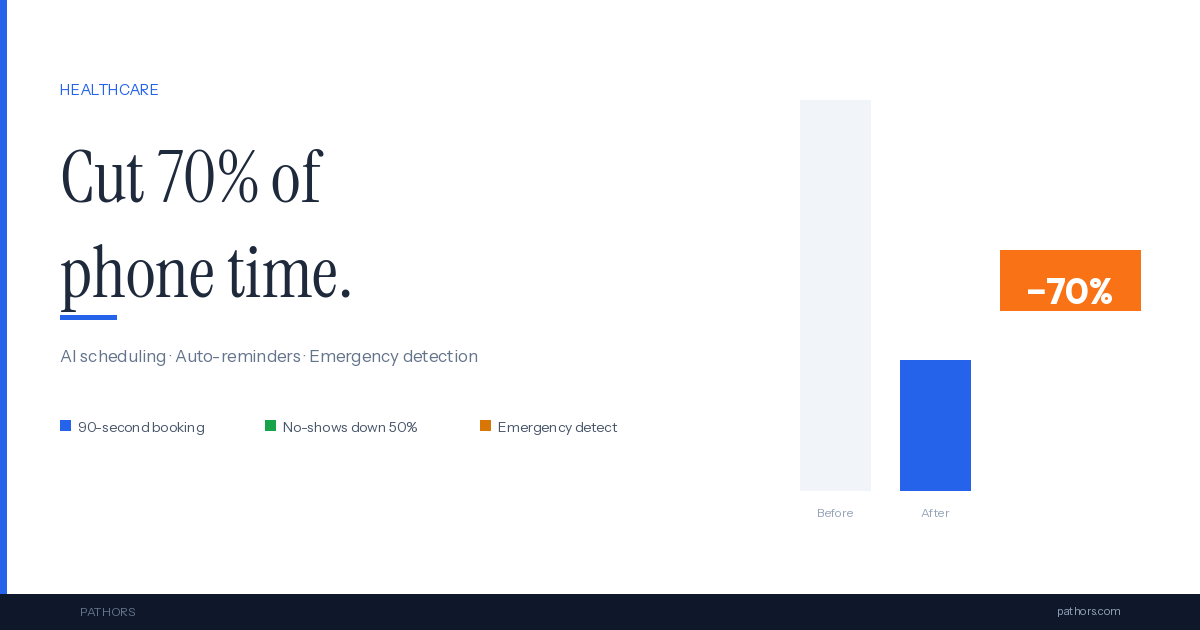
Small to mid-size clinics typically receive 30 to 80 phone calls per day. More than 60% of those calls are scheduling-related: new appointments, reschedules, and cancellations. Each call averages two to three minutes, which adds up to 1.5 to 4 hours of pure phone time daily — time the front desk isn't spending on the patients standing in front of them.
This is where AI appointment booking delivers its clearest ROI: not replacing reception staff, but offloading the high-volume, low-complexity calls so humans can handle what humans do best.
What AI Voice Agents Handle in a Clinic Setting
Automated Appointment Scheduling
A patient calls saying "I need to see a dermatologist next week." The AI voice agent confirms: which doctor (or no preference), preferred time window, and whether it's a first visit. It then checks the scheduling system for availability, books the slot, and sends an SMS with the appointment details and any pre-visit instructions.
The entire interaction takes about 90 seconds — roughly half the time of a human-handled call, because the AI isn't interrupted by walk-ins or other tasks.
Automated Pre-Visit Reminders
No-shows cost clinics more than most administrators realize. The average no-show rate for outpatient appointments runs 10–15%, and each empty slot represents wasted physician capacity. AI voice agents call patients 24 hours before their appointment to confirm attendance. Patients who can't make it are offered an immediate reschedule, and the freed slot is released to the waitlist.
FAQ Handling at Scale
"Are you open today?" "What documents do I need to bring?" "Do you accept my insurance?" "How much does a self-pay consultation cost?" These questions account for a significant share of incoming calls and require zero medical expertise to answer. The AI pulls answers from a knowledge base instantly, delivering more consistent information than a busy receptionist toggling between screens.
Healthcare-Specific Considerations
Medical settings demand more caution than restaurants or car dealerships. Three factors require special attention.
Patient Privacy
Appointment systems contain personally identifiable health information. Any AI platform must comply with local data protection regulations — in Taiwan, that means the Personal Data Protection Act (PDPA). Practically, this means the AI should not repeat diagnostic history or medication details over the phone. It handles scheduling data only. When evaluating platforms, confirm that data transmission is encrypted, call recordings have access controls, and the vendor has clear data retention policies.
Emergency Detection
The AI must recognize phrases like "I'm having chest pain" or "my child has a 40-degree fever" and immediately route the call to a human or instruct the caller to dial emergency services. This isn't just a feature requirement — it's an ethical baseline for any healthcare voice system.
Elderly Patient Experience
Clinics serve a disproportionately older demographic. Voice speed should be adjustable, language should be simple and direct, and in markets like Taiwan, dialect support (Taiwanese Hokkien) is a meaningful differentiator. Many elderly patients are more comfortable communicating in their native dialect.
The Numbers: What Clinics See After Deployment
Based on reported outcomes from healthcare AI implementations:
Perhaps the most important finding: patient satisfaction typically improves rather than declines. Most people calling to book an appointment have a clear, transactional goal — they want to get in and out quickly, not have a conversation. The AI's speed and accuracy actually deliver a better experience for this use case.
Implementation Roadmap for Clinics
Healthcare settings require a conservative rollout. Here's a three-phase approach that minimizes risk.
Phase 1 — Off-hours coverage. Start by routing calls during lunch breaks and after-hours to the AI. These calls currently go to voicemail (which most patients ignore), so AI handling is a strict improvement with zero disruption to existing workflows.
Phase 2 — Peak-hour assist. During the morning scheduling rush, let the AI handle overflow calls — when all lines are busy, new calls are picked up by the AI instead of going unanswered. Front-desk staff continue handling walk-ins and complex cases.
Phase 3 — AI as primary, human as backup. The AI becomes the first line for all incoming calls. Transfers to a human happen only for emergencies, complex medical questions, or explicit patient requests.
Pathors' conversational AI platform provides the bidirectional call support and visual SOP builder that clinics need to define exactly how each call type is handled. Upload your clinic's schedule, physician specialties, and common Q&A into the knowledge base, and the AI can go live quickly. Every conversation is logged with full monitoring and analytics for compliance review.
Want to evaluate whether AI appointment booking makes sense for your clinic? Book a free demo and we'll estimate the impact based on your actual call volume.
Brandon Lu
COO
Passionate about leveraging AI technology to transform customer service and business operations.
Ready to Transform Your Call Center?
Schedule a personalized demo and see how Pathors can revolutionize your customer service
Pathors empowers businesses with intelligent voice assistant solutions, streamlining customer service, appointment management, and business consulting to enhance operational efficiency.