E-Commerce Customer Service Automation: How AI Handles Returns and Order Tracking

Brandon Lu
COO
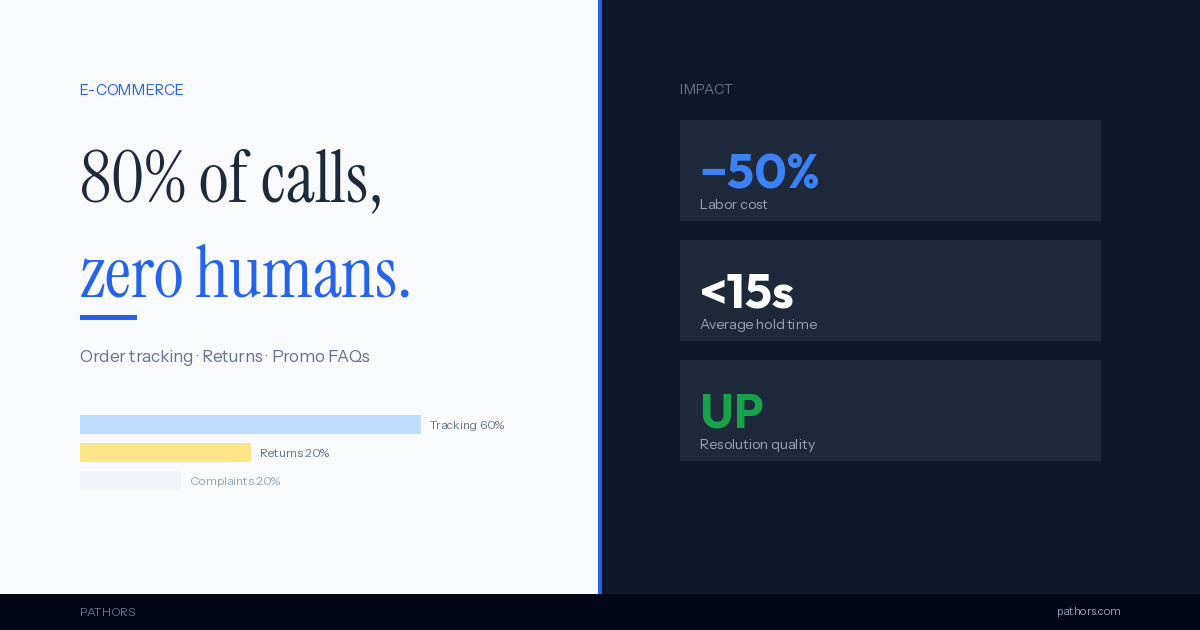
During a major sales event, your e-commerce customer service team receives 3,000 calls. Roughly 1,800 of them are asking the same question: "Where is my package?" Another 600 are return requests. The calls that genuinely require human judgment — escalated complaints, product consultations, edge cases — number around 600.
But your agents spend the same amount of time on all three types. The result: simple questions wait too long, complex ones don't get the attention they need, and overall customer satisfaction suffers across the board.
This scenario isn't limited to peak sale periods. For e-commerce operations processing more than 500 orders per day, order inquiries and return requests alone account for more than 60% of total inbound call volume. And nearly all of that 60% can be handled automatically by an AI voice assistant.
Four Applications of AI in E-Commerce Customer Service
1. Real-Time Order Status Inquiries
The traditional process when a customer calls about their order: the agent asks for an order number, looks it up in the system, and reads back the status. Average time: 2–3 minutes.
An AI voice assistant can complete the same task in under 30 seconds. The customer provides their order number or the phone number used at checkout, and the AI pulls the live logistics status from your OMS instantly — "Your package has shipped from our Taipei warehouse and is expected to arrive tomorrow afternoon." If the customer wants to change their delivery address or reschedule delivery, the AI can handle that too.
2. Automated Return and Exchange Processing
Returns are among the most time-consuming workflows in e-commerce customer service because multiple pieces of information need to be confirmed: order number, reason for return, item condition, and preferred refund method.
An AI voice assistant can walk the customer through the standard SOP: confirm the order → confirm the return reason (changed mind, wrong size, defective item) → determine the return process based on the reason (prepaid return label / in-store return / defective item replacement) → generate a return tracking number → send return instructions via SMS.
For cases like "defective item" that may require photo review, the AI can collect the basic information and then either direct the customer to upload photos via a provided link or transfer to a human agent for final determination.
3. Promotions and Coupon Questions
Another peak-period call category: "Why isn't my discount code working?" "When will the gift with my order ship?" "Can I use my loyalty points?"
These answers are usually on the promotion page, but customers don't want to find them. The AI pulls answers from the knowledge base instantly. When promotion rules are updated in the system once, all AI responses update automatically — eliminating the inconsistency that comes from different agents giving different answers.
4. Delivery Confirmation and Satisfaction Follow-Up
After an order is delivered, the AI can proactively call to confirm the customer received it and that the item arrived in good condition. Catching problems early — before a negative review goes live — is far more valuable than responding after the fact.
For high-value items or a new customer's first order, the AI can conduct a brief satisfaction survey a few days after delivery. The resulting data feeds directly back to product and operations teams.
The Numbers: What E-Commerce Brands See After Deployment
Customer service labor costs drop 40–60%. Not through layoffs, but because the same team can handle two to three times the order volume. Growth no longer requires proportional headcount increases.
Average call wait time drops from 3–5 minutes to under 15 seconds. AI handles simultaneous calls without queuing, with the most dramatic improvement during peak promotion windows.
Complaint handling quality improves. When AI absorbs the simple questions, human agents can invest more time and care in the complex complaints that actually require empathy and judgment.
Data accumulates automatically. Every AI-handled call generates structured data: what customers asked, return reason distribution, most-queried order statuses. This data feeds directly into product improvement, warehouse optimization, and marketing strategy.
Who Should Consider Deployment?
E-commerce operations with daily order volumes above 200 are worth a serious evaluation. If your team needs temporary staffing during major sales events, or if customer wait times regularly exceed 3 minutes, the ROI on AI voice assistance will typically be very high.
One important caveat: AI is best suited to standardized workflows — order inquiries, return processing, FAQ answers. For emotionally complex complaints, specialized product consultations, or disputes with legal implications, human judgment remains essential.
System Integration Requirements
For an AI voice assistant to deliver value in an e-commerce setting, it needs to connect with:
OMS/ERP — for order status, shipping details, and refund progress. CRM — to identify the customer, view purchase history, and check loyalty tier. Logistics API — for real-time package tracking and estimated delivery times. Ticketing System — for cases the AI can't resolve, automatically creating a ticket with a full conversation summary so human agents pick up without starting from scratch.
Pathors' AI voice assistant platform supports API and webhook integration with major e-commerce systems. The visual SOP builder lets you design every branch of your return workflow and order inquiry flow yourself — no coding required. Full conversation logs for every call are available in the monitoring dashboard, ensuring AI response quality stays consistent.
Dealing with customer service capacity crunches ahead of a major sales event? Book a free demo — we'll use your actual order volume and call data to model the impact of AI deployment.
Brandon Lu
COO
Passionate about leveraging AI technology to transform customer service and business operations.
Ready to Transform Your Call Center?
Schedule a personalized demo and see how Pathors can revolutionize your customer service
Pathors empowers businesses with intelligent voice assistant solutions, streamlining customer service, appointment management, and business consulting to enhance operational efficiency.